
Event bus in, review queue out.
Every email, document, position ping, and typed command becomes an event. Agents subscribe, work in parallel on shared memory, and everything consequential converges on one queue where humans decide.

One event bus
Inbound email, ELD pings, document arrivals, user commands — a single ordered stream. Nothing happens off the record, so nothing is invisible to audit.

One shared memory
Carrier records, load timelines, document facts, and rate memory live in one store. Vault's extraction is instantly Sentinel's evidence and Tracker's trigger.

One review queue
Exactly one drafting-and-approval pipeline exists. Every outbound message, payment release, and dispute action passes through it — and through a person.
Rules the software physically cannot break.
Guardrails are edges in the orchestration graph — structural, not persuasive. An agent can't be talked out of them because they aren't instructions; they're topology.
- R1 — Human approval Any send, payment, or dispute action halts the graph at an approval node until a person acts. The flagship rule — and the reason "AI" here never means "unsupervised."
- R2–R3 — Lanes & refusals Agents act only inside their mandate. Out-of-lane or rule-violating requests are refused with an explanation — and the refusal is logged like any other event.
- R4–R6 — Access, evidence, audit Answers are RBAC-filtered to the asking user's role. Claims carry sources. Sessions are checkpointed and replayable end to end — the evidence trail auditors ask for.
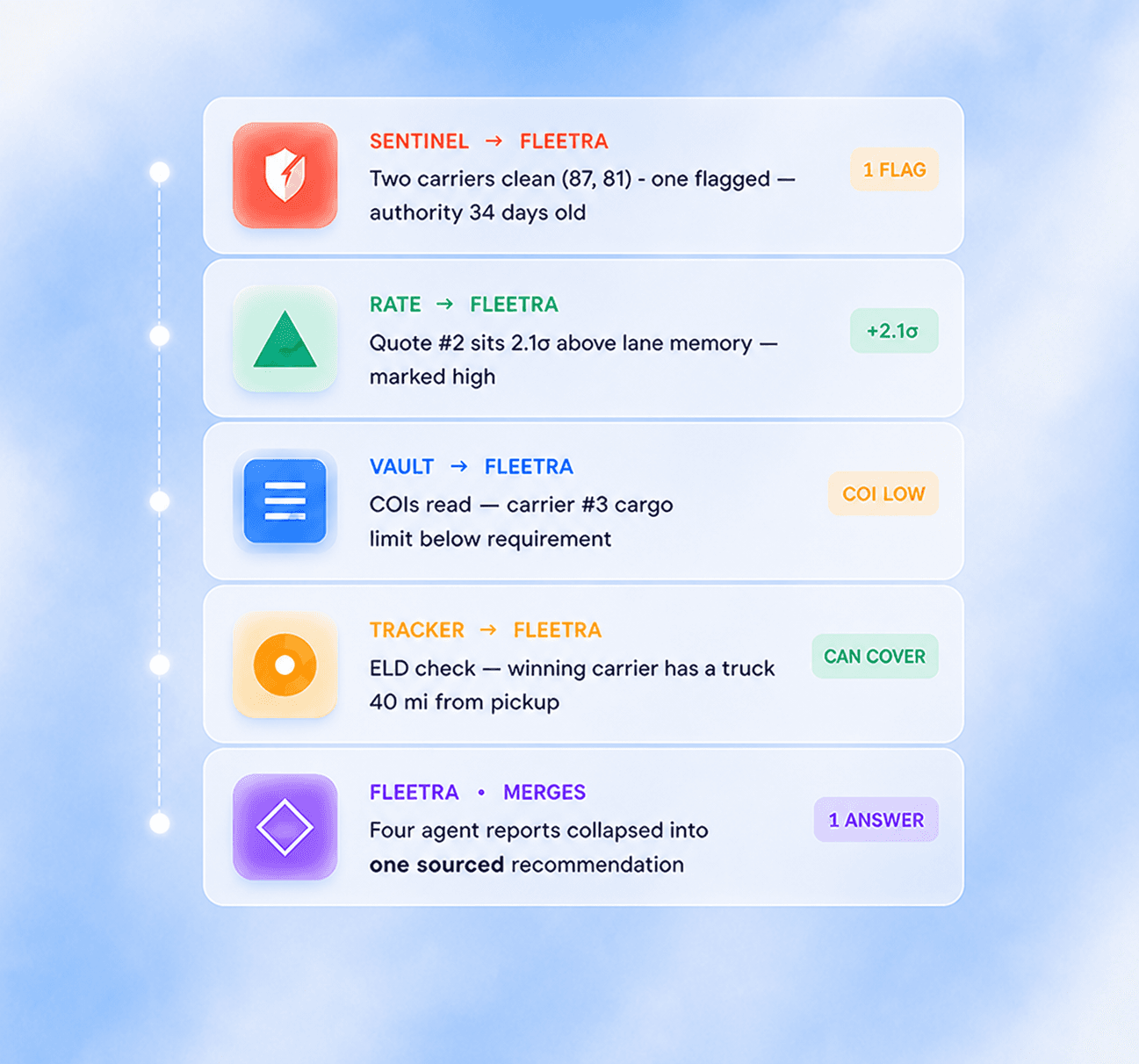
Why this couldn't be built on rented parts.
Three scenarios straight from the product — the kind of day the agents are built for
Data layer:
a 22.7M-row FMCSA warehouse we host — enabling census diffs, provenance on screen, and queries no rate-limited API allows
Document layer:
350,000+ insurance records plus every rate con, BOL, and POD your inbox receives — extracted once, reused everywhere
Payment layer:
DT Pay on Stripe rails — the release button that turns all that verification into enforcement

Bring your architect to the demo.
We'll walk the graph, the guardrails, and the audit trail — engineer to engineer.