

An assembly line for trust, not a chatbot with tools.
Every inbound event — an email, a document, a position ping, a typed command — lands on one event bus. Fleetra plans which agents the moment needs, runs them in parallel on shared memory, and merges one sourced answer. The division of labor is strict: Vault extracts, Sentinel judges; Rate computes, Fleetra delivers.

Shared memory
One carrier record, one load timeline, one document index. An insight any agent produces is instantly available to all of them — no swivel-chair, no copy-paste.
Guardrails as graph edges
Rules R1–R6 aren't prompt suggestions an agent might ignore. They're edges in the orchestration graph — a payment physically cannot route around the approval node.
Replayable sessions
Every run is checkpointed end to end. Ask "why did the system flag this carrier?" and get the exact evidence chain, step by step, months later.
Sentinel
Sentinel owns the trust question end to end. It renders the vet card inline in your inbox the moment a carrier email arrives, runs fraud detection on every message, watches the whole network for authority and insurance changes, and makes per-load coverage judgments on the facts Vault extracted.
- Inbound-sender vet card — email arrives → identity resolved → Trust Score + authority + insurance rendered inline
- Fraud scan on every carrier email — domain age, lookalike domains, phone-vs-FMCSA, signature-vs-MC
- Chameleon detection — monthly authority census diffs surface reincarnation signals: shared officers, addresses, phones with revoked MCs
- Batch CSV vetting — upload a carrier list, get back a scored sheet with flags
- Threshold alerts — a score falls through your floor, you know before dispatch does
Rate
Rate owns pricing truth. Inbound, every carrier quote in your email is extracted into tenant-siloed rate memory with source evidence. Outbound, a shipper RFQ triggers a DAT RateView fetch under your own license, your margin rules compute a sell price, and a reply lands in the review queue. The rented benchmark covers day one; your proprietary memory compounds forever — and it never trains anyone else's pricing.
- Quote capture — every emailed rate parsed to lane memory with the evidence attached
- Anomaly flags — a quote 2.1σ above your lane history gets marked before you reply
- RFQ → priced draft — DAT benchmark + your margin rules → sell price → drafted reply, human sends
- Negotiation cards — the carrier's last four quotes and your booked average, beside the email
Tracker
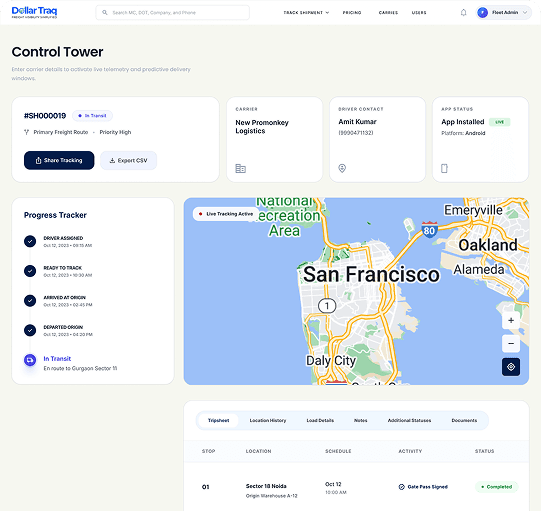
Tracker fuses live ELD position streams, geofences, and the status language parsed out of carrier emails into one load timeline — then acts early when the timeline slips. It starts automatically when Vault files a signed rate con, predicts late risk before the appointment is missed, drafts the check-call for a human to send, and emits 214-shaped status webhooks so your customer's TMS updates itself.
- Auto-init — tracking starts the moment a signed rate con is filed, no setup step
- Late-risk prediction — ETA math against appointments, flags raised hours early
- Drafted check-calls — carrier check-in and customer heads-up written, queued, human-sent
- TMS sync — 214-shaped webhooks keep the customer's system current without a phone call
Vault
Vault is the extraction layer for freight's paper. Every attachment entering a connected inbox is classified — COI, W-9, rate con, BOL, POD, NOA — parsed with a text-layer-first pipeline (vision-model fallback for scans), confidence-scored, and filed to the right carrier and load. Its facts feed everyone else: Sentinel's coverage judgments, Tracker's start signal, Rate's booked price, and DT Pay's human-authorized release.
- Classify + extract on arrival — no drag-and-drop, no re-keying, confidence scores on every field
- Holder verification — the certificate is checked against your requirement profile, not just parsed
- Expiry watch — T-15 renewal draft, T-7 escalation, dispatch hold if coverage lapses
- Low-confidence → human — an uncertain extraction is routed for review, never guessed
Fleetra
Fleetra is the supervisor every event and command passes through. It plans which agents a request needs, runs them in parallel, merges their structured outputs, and answers with sources. It owns the review queue and the single drafting pipeline — and its approval nodes are where the human-in-the-loop physically lives: any send, payment, or dispute action halts the graph until a person approves.
- Fan-out:one compound sentence becomes parallel work for three or more agents, returned as one sourced answer
- Late-risk prediction — ETA math against appointments, flags raised hours early
- RBAC-filtered answers:a user sees only what their role permits — nothing more
- One pipeline out:exactly one drafting-and-queue path exists; nothing sends from anywhere else
- Refuses out-of-lane requests with an explanation — and logs the refusal

Watch the agents work your carriers.
Bring a compound question to the demo — vet these three compare their quotes flag anything off and watch one sentence become four agents and one answer